

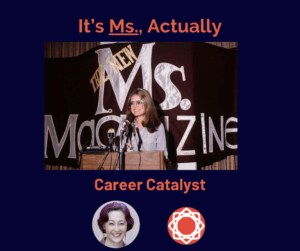
The passing of the great Gloria Steinem, a fellow Smith College alum, got me thinking about her legacy. One piece that’s always been meaningful for me is her advocacy for use of the address “Ms.” It wasn’t just the title of her magazine; it was a notion of equality that was central to her advocacy.
In case you didn’t know, starting in the 19th century, unmarried women are addressed as Miss So-and-So, and once they got married, they became Mrs. New-Surname. Men’s form of address, meanwhile, hasn’t changed according to marital status. You can see the issue here: why does marriage change the salutation for some of us and not the others? Furthermore, how would a stranger know how to address us?
As a form of address, “Ms.” is older than many of us realize. (The magazine was first published in 1972.) The term originated at the same time as “Miss” and “Mrs.,” less-common abbreviations of “Mistress.” Despite attempts to use it as a marriage-neutral salutation as early as 1901, it wasn’t widely adopted until the feminist movement, when advocates like Ms. Steinem and Geraldine Ferraro began using it. The publication of the magazine gave the term broader recognition.
The term isn’t without controversy, of course. There are still some women who feel that getting married is a cornerstone achievement and want recognition for that. There are plenty of men who find any form of feminism distasteful. But those are not the people I want in my orbit, so largely I ignore them. I simply can’t see how my marital status changes my standing in the world.
So in general, if you know the person you’re addressing is female-identified, go ahead and call her Ms. If she has a medical degree or a PhD., she’s Dr.